Advocacy
Project Worth works to close child protection gaps through prevention education, stronger reporting pathways, survivor-informed reform, and policy change that helps Wisconsin respond sooner.
How do we measure the worth of a child?
By the systems we build to protect them.
Reports Deserve Documentation, Pattern Review, and Protective Action
These truths belong together: delayed disclosure is common, false reports are uncommon, and child protection systems should be built to respond before harm continues.
Delayed Disclosure Is Common
Disclosure often occurs years later in adulthood, which is a well-documented pattern among survivors of child sexual abuse.
Systems must be built to recognize risk and act early.
False Reports Are Rare
Research estimates false report rates around 2-8%.
Reports should be documented carefully, reviewed for patterns, and taken seriously.
EVAWI; NSVRC, Lisak et al.Systems Must Carry the Responsibility
Because delayed disclosure is common and false reports are uncommon, systems should prioritize child safety, documentation, and early intervention.
Systems should not rely on survivors to expose harm after the fact.
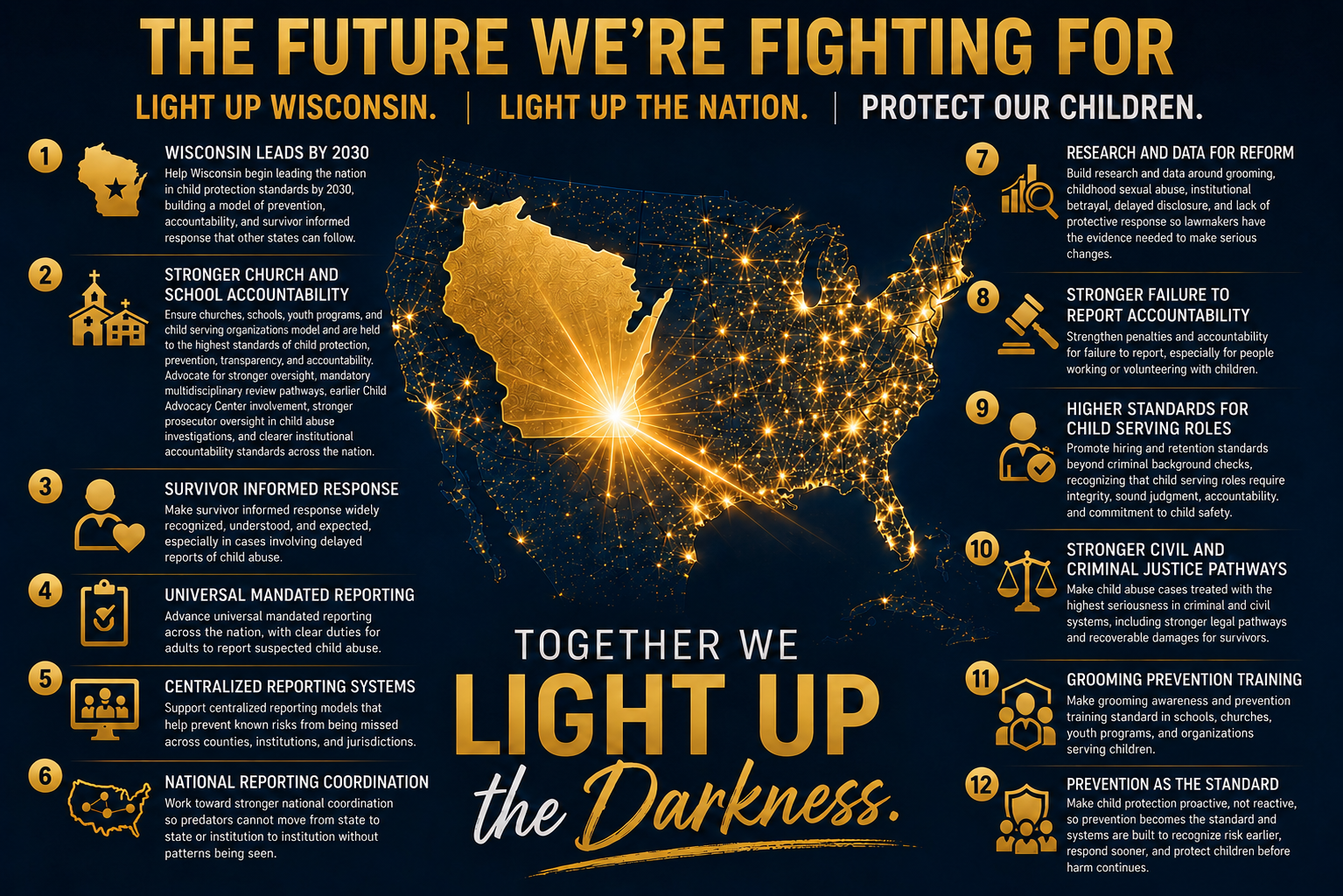
The Future We’re Fighting For
Project Worth is working to identify the strongest child protection policies already being used across the country, study where Wisconsin is falling behind, and help bring the best protections here.
The goal is simple: make Wisconsin the safest state for children in the nation by 2030. Then help make that protection the standard for every child in the United States.
Does one of these areas speak to you? We would love to connect you with the team members helping move that work forward.
Let’s give survivors their voices and power back, not the people or systems who took it from them.
Wisconsin is far behind many states in mandated reporting and child protection accountability.
Use each issue card to see where Wisconsin falls short, what stronger states are already doing, and why Project Worth is pushing for reform that protects children sooner.
Learn more
Wisconsin is in the minority of states without a centralized statewide child abuse reporting system.
Reports can remain divided by county, agency, institution, or jurisdiction, making it harder to identify patterns, repeat offenders, and ongoing risks to children.
Wisconsin reports are handled through individual county and tribal agencies, while many states use statewide hotlines, centralized intake, or state registry models.
Why this matters: County based reporting can lead to inconsistent screening, documentation, follow through, and pattern tracking.
Sources: Wisconsin DCF CPS Process · Wisconsin DCF Report Abuse · Child Welfare Information Gateway State Reporting Numbers
Learn more
Many states now require all adults or all persons to report suspected child abuse.
Wisconsin still relies on limited mandated reporter categories, leaving gaps where adults may suspect abuse but not have a clear legal duty to report.
Wisconsin still relies on specific mandated reporter categories, while many states require all adults or all persons to report suspected child abuse.
Why this matters: When reporting duties depend on a person’s legal category, suspected abuse can fall into silence when adults are unsure whether they are required to act.
Sources: Wisconsin Mandated Reporter Law · Child Welfare Information Gateway Mandatory Reporters · State Reporting Laws
Learn more
Churches, schools, and child serving organizations should be held to the highest standards of child protection because they hold some of the deepest public trust. They should face serious accountability when they fail to report, ignore warning signs, silence survivors, or protect their reputation over children.
Yet Wisconsin leaves significant discretion to individual law enforcement agencies and detectives, with limited oversight and no automatic pathway requiring broader review by Child Advocacy Centers or prosecutors when reports involve potential child abuse within trusted institutions.
Why this matters: Institutional silence can preserve access to children, protect reputations over safety, and prevent broader review of serious concerns.
Sources: Wisconsin Clergy Reporting Law · Child Advocacy Center Models · Project Worth Institutional Accountability Research
Learn more
Wisconsin CPS does not accept reports from adult survivors of childhood abuse.
This is a serious child safety failure. Adult survivor reports can reveal current risk, especially when the alleged offender still has access to children.
Illinois DCFS centrally logged Kerri’s report of abuse that primarily occurred in Wisconsin from 2010 to 2012. Wisconsin CPS has no record of it.
Adult survivor reports should be accepted, logged, retained, and reviewed for patterns.
Wisconsin CPS does not provide a clear intake pathway for adult survivors reporting childhood abuse, even when the alleged offender may still have access to children.
Why this matters: Adult survivor reports can reveal current risk, repeat offenders, and patterns that children may not be able to report themselves.
Sources: Wisconsin DCF CPS Process · Illinois DCFS Reporting · The Spark
Learn more
Many states have higher penalties when people who work or volunteer with children fail to report suspected child abuse.
Wisconsin needs stronger consequences for child serving adults who fail to report. A person trusted with access to children should face serious accountability when their silence leaves children at risk.
Wisconsin needs stronger consequences when child serving adults fail to report suspected abuse, especially when their silence allows continued access to children.
Why this matters: Adults who work or volunteer with children hold special trust and should face meaningful accountability when they fail to act on safety concerns.
Sources: Wisconsin Mandated Reporter Law · Child Welfare Information Gateway Penalties · State Reporting Laws
Learn more
Many states recognize that power imbalances do not automatically end when a young person turns 18.
Washington criminalizes sexual misconduct by a school employee with an enrolled student ages 16 to 21 when the employee is at least 60 months older. Texas criminalizes improper relationships between educators and students, including adult students.
Wisconsin’s protections are still centered on minors. Wisconsin should recognize authority based sexual abuse involving young adults when the offender holds power as a teacher, coach, clergy member, mentor, youth leader, or other trusted authority figure.
Many states recognize that authority and coercive control can continue after a young person turns 18, especially in schools, churches, coaching, mentoring, and youth leadership settings.
Why this matters: Power imbalances do not disappear at adulthood, and young adults can still be vulnerable to abuse by trusted authority figures.
Sources: Washington Sexual Misconduct Law · Texas Educator Relationship Law · Project Worth Policy Research
Learn more
Illinois has removed criminal and civil statutes of limitations for childhood sexual abuse. Wisconsin has not.
Wisconsin still places time limits on survivors seeking justice, including civil claims that can be barred at age 35 and criminal gaps depending on the charge.
That is the issue.
These deadlines ignore grooming, trauma, delayed disclosure, institutional betrayal, and the reality that many survivors are not ready or able to pursue justice within the state’s timeline.
Minnesota recognized that past survivors were failed and opened a lookback window. Wisconsin should do the same.
Survivors should not be timed out of justice while offenders and institutions are protected by the clock.
Wisconsin still has time limits that can prevent survivors from pursuing criminal or civil justice, including civil claims that may be barred at age 35.
Why this matters: Deadlines often ignore grooming, trauma, delayed disclosure, institutional betrayal, and the reality that many survivors need years before they can seek justice.
Sources: Wisconsin Statutes · Illinois Childhood Sexual Abuse Limitations · Minnesota Child Victims Act
Learn more
Civil accountability can be difficult in Wisconsin when cases involve grooming, abuse of authority, delayed disclosure, or institutional patterns that do not fit neatly within existing precedent.
In Kerri’s case, Illinois offered a stronger civil pathway than Wisconsin, even though the reported abuse occurred primarily in Wisconsin.
Project Worth supports stronger survivor centered civil protections, including clearer pathways for grooming based child abuse claims, stronger institutional accountability, and higher recoverable damages for child abuse cases.
Financial harms like fraud, property damage, or business disputes can have clearer recovery pathways than grooming based child abuse. Survivors deserve legal pathways that reflect the seriousness and lifelong impact of abuse.
Illinois and Minnesota allow many civil childhood sexual abuse claims to be brought at any time, and Minnesota previously created a Child Victims Act lookback window for expired claims.
Wisconsin civil pathways can be difficult when cases involve grooming, authority abuse, delayed disclosure, or institutional patterns that do not fit neatly within existing precedent.
Why this matters: Survivors deserve legal pathways that reflect the seriousness and lifelong impact of grooming based child abuse and institutional failure.
Sources: Illinois Civil Law · Minnesota Child Victims Act · Project Worth Civil Accountability Research
Learn more
Recoverable damages in child abuse cases should reflect the lifelong harm survivors carry.
Wisconsin should pursue the highest recoverable damages possible in child abuse cases, both civilly and criminally, so survivors are not left carrying the cost while offenders and institutions avoid meaningful accountability.
🏛️ Low damages can weaken accountability
Recoverable damages in child abuse cases should reflect the lifelong financial, emotional, and personal harm survivors may carry.
Why this matters: Low recoverable damages can weaken accountability and leave survivors carrying the cost while offenders and institutions avoid meaningful consequences.
Sources: Wisconsin Civil Remedies · Survivor Justice Research · Project Worth Policy Research
Learn more
Wisconsin needs stronger grooming awareness and prevention training in schools, churches, nonprofits, youth programs, and child serving organizations.
Grooming should be recognized before abuse escalates, not explained away after a child has already been harmed.
Wisconsin needs stronger grooming awareness and prevention training in schools, churches, nonprofits, youth programs, and child serving organizations.
Why this matters: Grooming should be recognized before abuse escalates, not explained away after a child has already been harmed.
Sources: NSVRC · EVAWI · Grooming Prevention Research
Learn more
Wisconsin child protective systems largely focus on abuse and neglect involving parents, caregivers, and family settings.
That leaves major gaps when abuse involves churches, schools, youth programs, coaches, volunteers, mentors, or other trusted adults outside the home.
Wisconsin child protective systems largely focus on parents, caregivers, and family settings, leaving weaker pathways when abuse involves trusted adults outside the home.
Why this matters: Children are also harmed in schools, churches, youth programs, and other trusted spaces where adults may hold access, authority, and influence.
Sources: Wisconsin DCF CPS Process · Child Welfare Information Gateway · Project Worth Policy Research
Learn more
Wisconsin’s systems are too reactive.
Child protection should not wait until harm is repeated, public, severe, or impossible to deny. Wisconsin needs prevention, early reporting, pattern tracking, adult survivor reporting, grooming recognition, and serious accountability before more children are harmed.
Wisconsin’s child protection systems often respond after harm has escalated instead of focusing on prevention, pattern tracking, and earlier intervention.
Why this matters: Child protection should not wait until harm is repeated, public, severe, or impossible to deny before systems act.
Sources: Wisconsin DCF CPS Process · Child Welfare Information Gateway · Project Worth Prevention Research
"Wisconsin is an outlier in many key areas of child protection. We want to change that."
Prevention, Policy, and Healing
Project Worth is working to identify the strongest child protection policies already being used across the country, study where Wisconsin is falling behind, and help bring the best protections here.
The goal is simple: make Wisconsin the safest state for children in the nation by 2030.
Then help make that protection the standard for every child in the United States.
See more in future projects below.
Learn more
Problem addressed: No Centralized Statewide Reporting System
Project Worth is researching centralized child abuse reporting models used in other states and advocating for Wisconsin to move beyond fragmented county based reporting. The goal is a statewide system that can document reports, connect patterns, identify repeat risks, and help protect children earlier.
Learn more
Problem addressed: No Universal Mandated Reporting
Project Worth is studying states that require all adults to report suspected child abuse and building support for Wisconsin to adopt universal mandated reporting. The goal is to make reporting suspected child abuse a clear responsibility for every adult, not only certain professional categories.
Learn more
Problem addressed: Weak Wisconsin Church and School Accountability
Project Worth is advocating for churches, schools, youth programs, and child serving organizations to be held to the highest standards of child protection and accountability. We are raising awareness around Wisconsin’s clergy reporting loopholes, weak institutional accountability, failures to respond to grooming concerns, and the lack of automatic multidisciplinary review when child safety concerns are reported within trusted institutions. This project supports stronger reporting systems, earlier multidisciplinary review, greater institutional accountability, and protections that prioritize children over reputation management, internal handling, or silence.
Learn more
Problem addressed: Wisconsin Child Protective Systems Refuse Adult Survivor Reports of Childhood Abuse
Project Worth is working to create a clear pathway for adult survivors to report childhood abuse when the alleged offender may still have access to children. The goal is for Wisconsin to accept, log, retain, and review adult survivor reports as serious child safety information.
Learn more
Problem addressed: Weak Penalties for Failure to Report by Child Serving Adults
Project Worth is researching states with stronger penalties for adults who work or volunteer with children and fail to report suspected abuse. The goal is to make failure to report a serious accountability issue in Wisconsin, especially for adults trusted with access to children.
Learn more
Problem addressed: Wisconsin Does Not Recognize That Authority Based Abuse Can Continue After 18
Project Worth is researching states that recognize authority based sexual abuse involving young adults, including protections that extend beyond age 18. The goal is for Wisconsin to recognize that power imbalances do not automatically end when a young person becomes a legal adult.
Learn more
Problem addressed: Wisconsin Still Bars Child Abuse Survivors from Criminal and Civil Justice at Age 35
Project Worth is studying states like Illinois and Minnesota that have removed or expanded statutes of limitations for childhood sexual abuse. The goal is to help Wisconsin stop timing survivors out of justice before they are ready or able to come forward.
Learn more
Problem addressed: Weak Civil Accountability for Grooming and Institutional Failure
Project Worth is working with legal advocates to identify civil gaps involving grooming, abuse of authority, delayed disclosure, institutional patterns, and weak precedent. The goal is to build stronger survivor centered civil pathways in Wisconsin.
Learn more
Problem addressed: Limited Recoverable Damages for Child Abuse
Project Worth is researching how recoverable damages in child abuse cases can better reflect lifelong harm. The goal is for Wisconsin to pursue the highest recoverable damages possible so survivors are not left carrying the cost while offenders and institutions avoid meaningful accountability.
Learn more
Problem addressed: Lack of Grooming Recognition and Prevention Training
Project Worth is developing grooming awareness and prevention resources for schools, churches, nonprofits, youth programs, and child serving organizations. The goal is to make grooming prevention standard training in Wisconsin.
Learn more
Problem addressed: Narrow Family Focus in Child Protective Systems
Project Worth is identifying gaps in Wisconsin’s response when abuse involves trusted adults outside the home, including churches, schools, coaches, mentors, volunteers, youth leaders, and child serving organizations. The goal is to build a child protection model that recognizes risk beyond parents and caregivers.
Learn more
Problem addressed: Reactive Instead of Preventive Child Protection
Project Worth is building a prevention first child protection model by combining stronger reporting, grooming education, pattern tracking, survivor reporting, institutional accountability, and earlier response. The goal is to make Wisconsin a national leader in proactive child protection.
“Those who work or volunteer with children must meet a higher standard of integrity, not simply the absence of a criminal record.”
The Case for Change
Learn more about Wisconsin’s system gaps and the policy changes we’re working toward.
Explore the research, laws, and real-world gaps shaping this work.
Volunteer With Purpose🔎Partner in Prevention and Policy Research
Project Worth welcomes researchers, students, advocates, policy minds, and community members who want to help evaluate what is working in child protection, what is failing, and what Wisconsin can learn from stronger models in other states.
Interested in helping us research, review, or compare child protection policies?
Explore the Case for Change and help us Light the Way.
Where Advocacy Leads
I hope Project Worth encourages child serving organizations to pause, reflect, and strengthen how they protect children, so this advocacy leads to safer policies, stronger prevention, and lasting change for the children who come next.
★ Prevention means acting on patterns before harm continues, not waiting until a child has to carry the burden of proving what happened.